

Duplicate a Scenario
Overview
Section titled “Overview”Duplicate creates a brand-new Website Scenario from an existing one, copying its configuration and recorded session so you don’t have to record it again. The duplicate is a new, independent scenario - it starts with a clean run history and never affects the scenario you copied from.
Duplicating a scenario is useful when you want to:
- Reuse a working flow for a similar page, environment, or region.
- Create a staging copy of a production scenario (or the other way around).
- Experiment with schedule, or location changes without touching the original.
- Use a known-good recording as the starting point for a new flow.
What Gets Copied
Section titled “What Gets Copied”- The full scenario configuration - target, evaluation rules, audits, headers, location, schedule, and so on.
- The recorded session - the duplicate starts with the same recorded browser flow and reference screens as the source, so it’s ready to run immediately.
Recording behavior
Section titled “Recording behavior”TestCLIX duplicates the recording attached to the scenario’s current, saved version only.
- If a re-recording is in progress on the source (for example, someone is editing or regenerating it in the Codeless Recorder), that unsaved work is not copied. The duplicate always takes the last saved recording, never in-progress changes.
- This keeps duplicates predictable: you get exactly what the source scenario looks like right now, not a half-finished edit.
What Is Not Copied
Section titled “What Is Not Copied”The duplicate is a new, independent scenario and inherits no history from the source:
- No past results, statuses, or trends.
- No Session Player recordings from previous runs.
- No triggered alarms or notification history.
What You Can Change While Duplicating
Section titled “What You Can Change While Duplicating”Anything you leave untouched is inherited from the source scenario.
| Setting | Required? | Notes |
|---|---|---|
| Name | Yes | Up to 32 characters. |
| Parent directory | No | Where the duplicate is placed. Defaults to the source’s directory. |
| Location | No | Run the duplicate from a different region. |
| Schedule | No | Turn scheduled monitoring on or off for the duplicate. |
How to Duplicate a Scenario
Section titled “How to Duplicate a Scenario”-
Find the scenario you want to copy in your workspace.
-
Open the three-dot menu and choose Duplicate scenario.
-
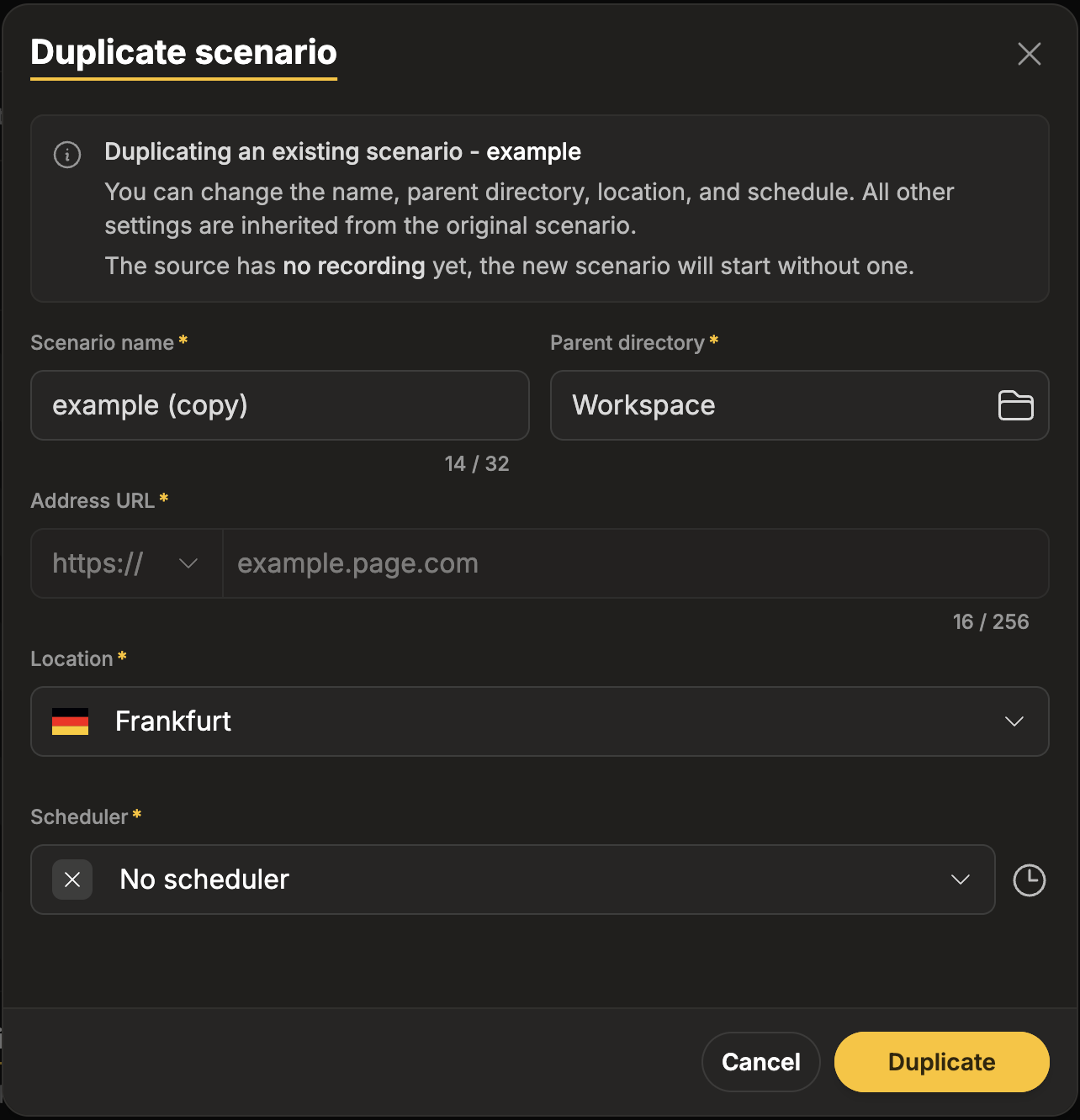
In the Duplicate scenario dialog, review the Name. It is prefilled with a default based on the source - edit it if you want.
Default: “Checkout (copy)” (for a source scenario named Checkout)
-
(Optional) Adjust Parent directory, Location, Schedule.
-
Click Duplicate. TestCLIX creates the new scenario and opens it, ready to run.
Validation rules
Section titled “Validation rules”- The Name is prefilled with <source name> (copy). You can keep it or replace it.
- Name is required and limited to 32 characters. If the default name would exceed 32 characters, it is trimmed to fit - shorten it further if you like.
“Name is required.” “Name must be 32 characters or fewer.”
Edge Cases & Behavior
Section titled “Edge Cases & Behavior”- Scenario with no recording - the duplicate is created from the configuration alone. There is no recording to copy, and no error is shown.
- Re-recording in progress on the source - in-progress work is ignored; the duplicate uses the last saved recording. (See Recording behavior.)
- Recording copy fails - the new scenario is still created, but its recording could not be copied. TestCLIX tells you which scenario was created so you can fix it rather than losing your work (see Error Handling).
- Read-only role - the Duplicating action is hidden or disabled. Ask a project Admin for write access.
Error Handling
Section titled “Error Handling”| What happened | What you see | What to do |
|---|---|---|
| Name missing or too long | ”Name is required.” / “Name must be 32 characters or fewer.” | Enter a name of 32 characters or fewer. |
| No write permission | The Duplicate action is unavailable. | Request write access - see Roles & Permissions. |
| Recording copy failed | ”The scenario was created, but its recording could not be copied. Open the new test to re-record it.” | Open the created duplicate and regenerate the recording in the Codeless Recorder. Do not duplicate again - that would create a duplicate. |
Best Practices
Section titled “Best Practices”- Name for context, not just uniqueness. With only 32 characters, favor short, meaningful names like
Checkout – EUorLogin (staging). - Inherit by default, override on purpose. Change a setting only when the duplicate genuinely needs to differ.
- Change location for regional copies. Duplicating per region is the cleanest way to monitor the same flow from multiple places.
- Verify visual duplicates once. After duplicating, run the scenario once to confirm the copied recording still matches the target before relying on it.
Related
Section titled “Related”Does duplicating affect the original scenario?
No. The duplicate is fully independent. Changing or deleting it never affects the source, and vice versa.
Will the duplicate include past results and Session Player recordings?
No. A duplicate starts with a clean history and builds its own results from its first run.
Someone was editing the recording when I duplicated. Which version did I get?
The last saved recording. In-progress re-recordings are never copied into a duplicate.