
Statuses
Introduction
Section titled “Introduction”Website Vitals statuses help you quickly understand the current state of a Website Vitals test.
Website Vitals statuses
Section titled “Website Vitals statuses”| Status | Description |
|---|---|
| Queued | The vitals test configuration is valid and queued for execution, for example after a manual trigger or scheduler event. |
| Pass | The vitals test executed successfully. All configured thresholds were met and performance insights are available. |
| Error | The vitals test execution failed due to an error in one or more metrics or due to a technical failure during the run. |
| Acknowledged | The vitals test execution failed, but the error has been acknowledged and is being handled. |
Where statuses appear
Section titled “Where statuses appear”Website Vitals statuses are visible in several places in TestCLIX:
-
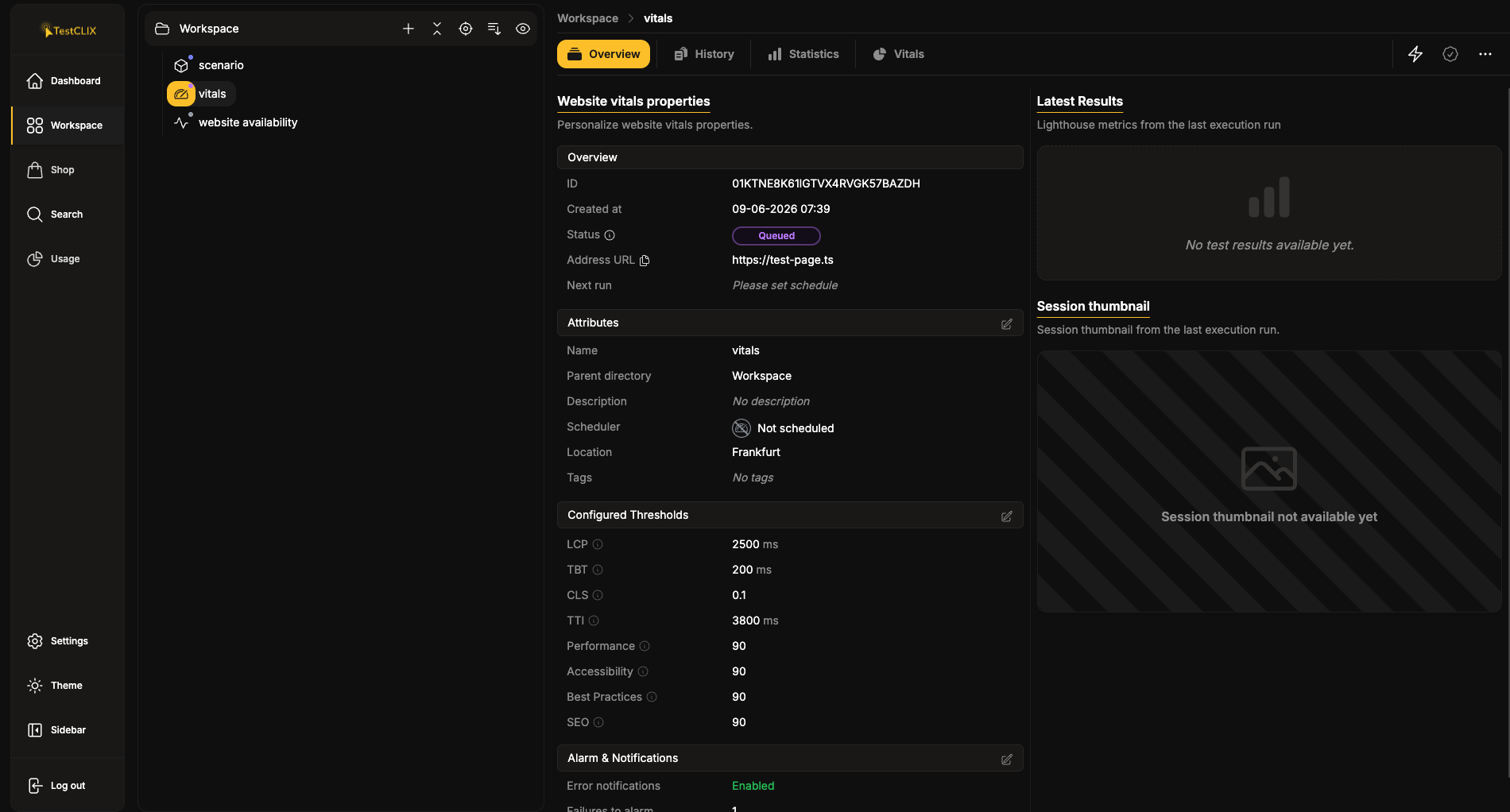
Workspace – in the workspace tree, each Website Vitals test displays a colored status indicator (dot) showing its current state. In workspace grid and table views, the current scenario status is displayed as a status badge, such as Pass, Error, or Acknowledged.
-
Website Vitals overview – the Overview tab displays the current Website Vitals status together with the latest Lighthouse results and threshold configuration.
-
History – the History tab shows how the Website Vitals status changed over time and how individual runs contributed to these changes.
History
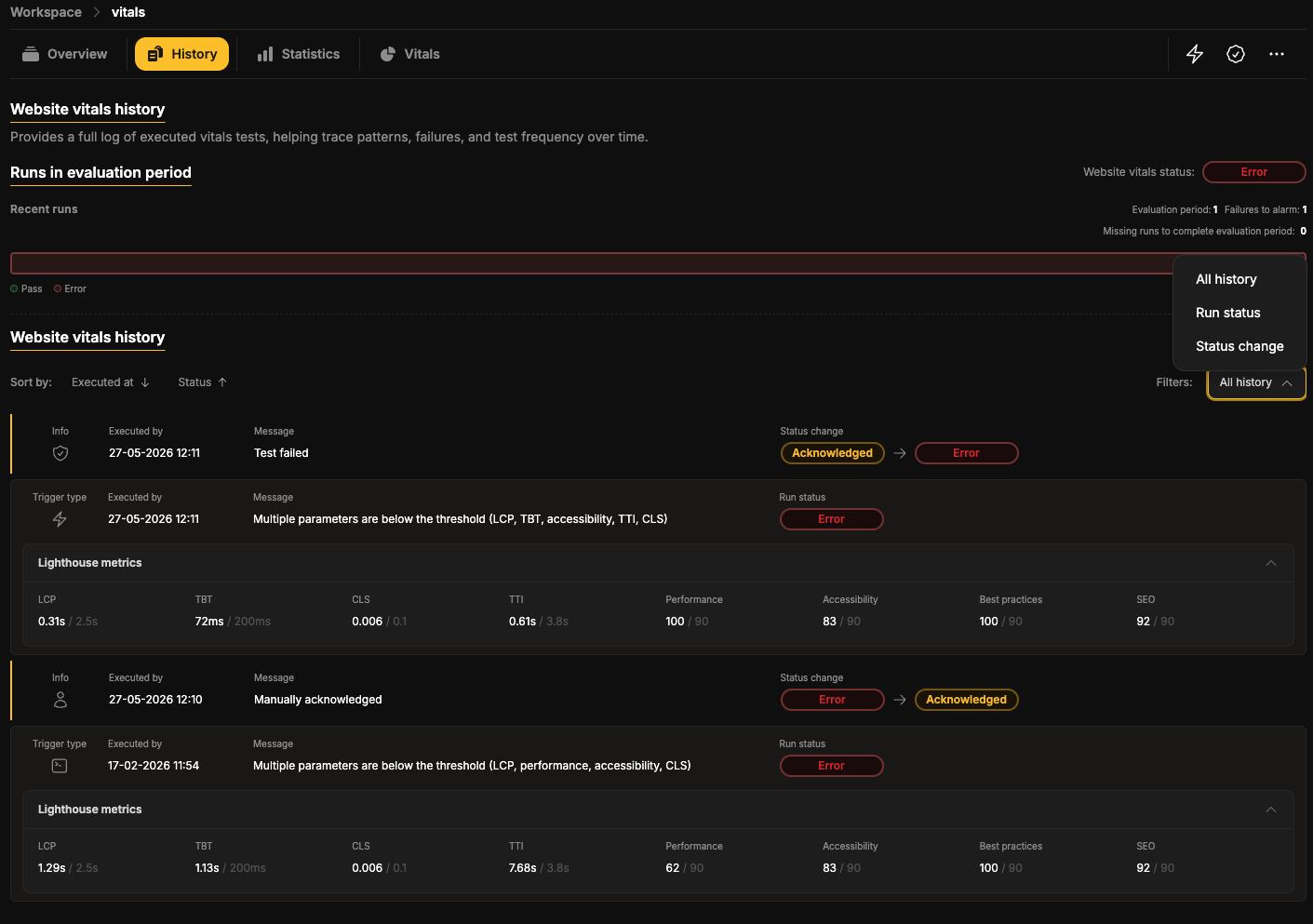
Section titled “History”The History tab combines two types of information:
- Run history – individual Website Vitals executions
- Status changes – transitions between Website Vitals statuses
This helps track both metric-level regressions (for example, LCP above threshold) and the resulting status updates.
Runs in evaluation period
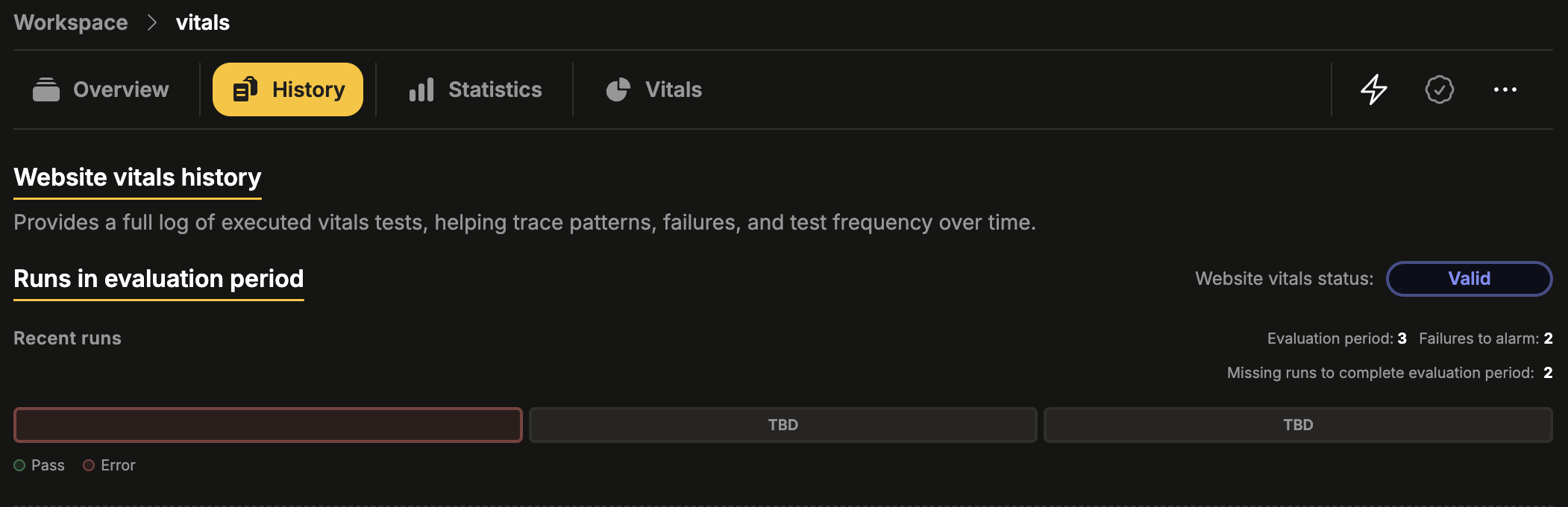
Section titled “Runs in evaluation period”The Runs in evaluation period section displays Website Vitals executions included in the current evaluation window.
It also shows:
- Website Vitals status – the current overall Website Vitals state.
- Evaluation period – the number of recent runs (1–50) taken into account when evaluating the status.
- Failures to alarm – the number of failed runs required before the Website Vitals enters the Error status.
When the configured failure threshold is reached, TestCLIX changes the scenario status to Error.
For more information, see Alarm and Notifications.
Run status
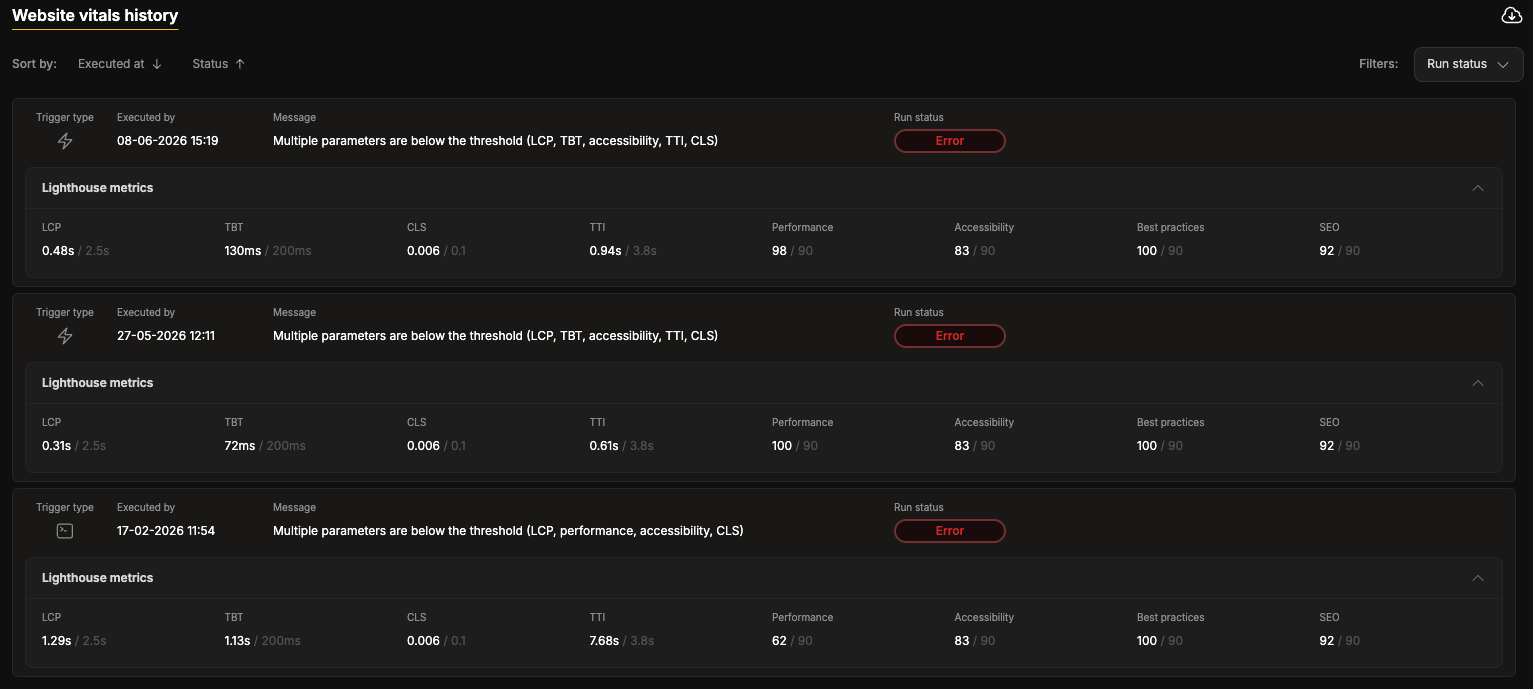
Section titled “Run status”Run status represents the result of a single Website Vitals execution. This is the default filter in the Website Vitals history section.
Each run entry includes:
- Trigger – how the run started
- Executed at – execution timestamp
- Message – execution details or failure reason
- Run status – execution result, such as Error or Pass
- Lighthouse metrics – metric values such as LCP, TBT, CLS, TTI and Lighthouse scores for Performance, Accessibility, Best Practices, and SEO
Trigger types
Section titled “Trigger types”| Trigger | Description |
|---|---|
 | Started manually by a user. |
 | Started automatically by the configured scheduler at a defined interval or time. |
 | Started automatically by TestCLIX as part of an internal system action or background processing. |
Status change
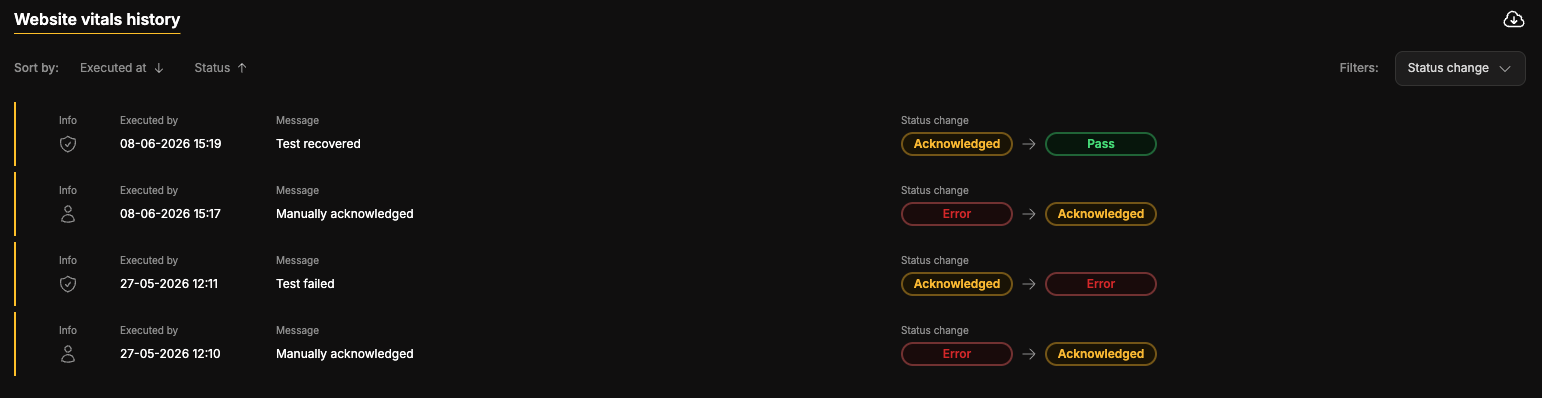
Section titled “Status change”Status changes describe transitions between Website Vitals states. This is another filter in Website Vitals history.
Examples:
- Error → Acknowledged
- Acknowledged → Error
- Error → Pass
Each record contains:
- Info – additional context
- Executed at – when the change happened
- Message – transition reason
- Status change – previous and current status
Common messages include:
- Manually acknowledged
- Test recovered
- Test failed
Manual acknowledgement
Section titled “Manual acknowledgement”When a a Website Vitals test enters the Error status, you can acknowledge the error to indicate that the issue is known and is being investigated.
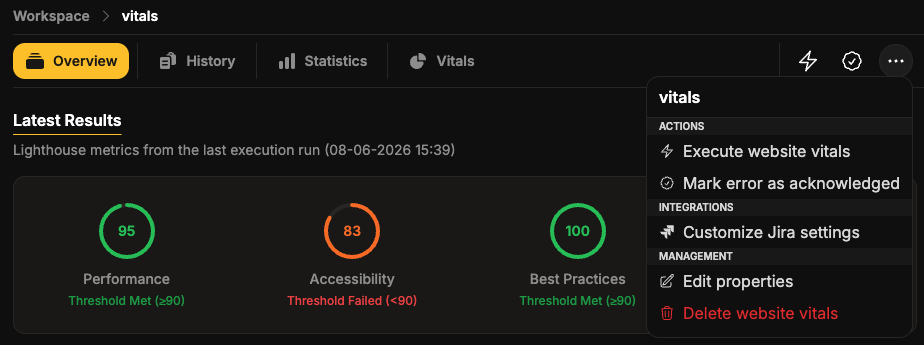
You can acknowledge an error in one of the following ways:
-
Locate the Website Vitals test you want to update.
-
Open the three-dot menu.
-
Select Mark error as acknowledged.
-
Open the Website Vitals details page.
-
In the top action panel, click the Mark error as acknowledged icon.

The acknowledgement is recorded in History as a status change entry with the message Manually acknowledged.
If a later run succeeds, TestCLIX automatically updates the scenario status and adds an entry such as Test recovered.